Loading...

Leasing Decreased in Q3 2021, But Remains a Critical Option for Affordability

by Melinda Zabritski 2 min read January 11, 2022

Young woman standing against glass window at car showroom

There is no doubt the automotive finance market continues to see impacts and shifts resulting from the pandemic. One of the changes we saw was a drop in leasing. While many trends have returned to pre-pandemic levels, leasing has not. In fact, it’s continued to decrease.

According to Experian’s State of Automotive Finance Market: Q3 2021 report, leasing comprised 24.03% of new vehicle financing in Q3 2021, compared to 27.62% in Q3 2020, and 30.51% in Q3 2019.

Some attribute the drop in leasing to consumers extending their current leases or purchasing their vehicles once the lease expires—a cost-effective way to purchase a vehicle, particularly amid rising prices. But while we don’t know the exact reasons driving the decrease in leasing, we do know that it continues to be a vital option for consumers looking for a lower monthly payment on a vehicle.

In Q3 2021, the average monthly lease payment was $506, compared to the average monthly loan payment for a new vehicle, which hit a record high of $617. With the average new vehicle monthly payment more than $100 higher, consumers shopping for a vehicle based on monthly payment may opt for a lease, rather than a loan.

For example, in Q3 2021, the Ford F150 had an average monthly lease payment of $542, while the average monthly loan payment was $768. Consumers also continue to opt for CUVs, such as the Jeep Grand Cherokee, which had an average monthly lease payment of $470, compared to the average loan payment of $608.

Consumers still choosing bigger vehicles

In recent years, consumers have been looking for larger, more expensive vehicles like SUVs, CUVs and full-size pickup trucks, and the pandemic has not altered these preferences at all, which is demonstrated by the top 10 vehicles leased in Q3 2021.

It is important to note that the Honda Civic was the top leased vehicle, accounting for 2.92% of leasing, but also the only sedan among the top ten—the rest being made up by SUVs, CUVs, and full-size pickups.
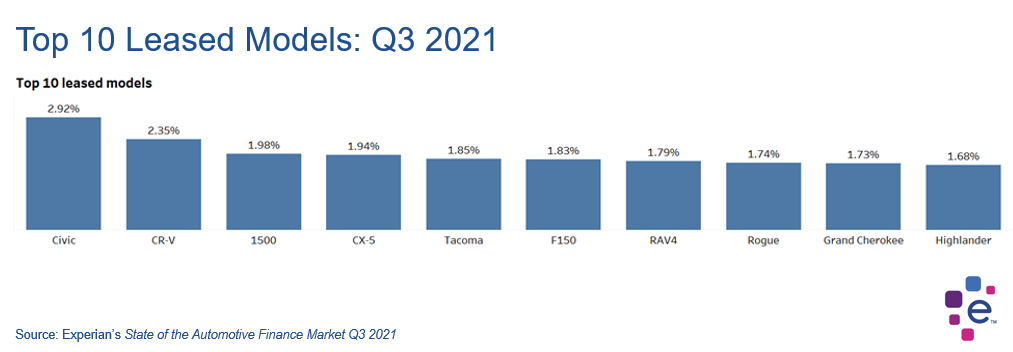
bar chart showing the top ten leased vehicles in Q3 2021

With consumers opting for larger and more expensive vehicles, leasing will continue to remain an important option for those looking to get a new vehicle with a lower monthly payment. It also has a large impact on the used vehicle market in the future—the leases of today are the used vehicles of tomorrow.

As we continue to see challenges like the inventory shortages, data can help dealers and lenders properly navigate their way through this evolving trend and help consumers choose the vehicle that best fits their budget and needs.

To learn more about leasing and other automotive finance trends, watch the entire State of the Automotive Finance Market: Q3 2021 webinar.


Related Posts

  As vehicle prices and interest rates continue to evolve, both consumers and lenders are recalibrating their approaches to affordability and long-term sustainability. This shift has resulted in the subprime segment growing to its largest share of total finance market for subprime in the fourth quarter since 2021. According to Experian’s State of the Automotive Finance Market Report: Q4 2025, subprime borrowers accounted for 15.31% of total vehicle financing, an increase from 14.54% in Q4 2024. To understand why the subprime space is evolving, we took a deeper dive into the affordability picture and how changes in pricing and interest rates are influencing both consumer decisions and lender strategies. In Q4 2025, the average loan amount for a new vehicle increased $1,882 from the prior year to $43,582, and the average interest rate for a new vehicle went from 6.34% last year to 6.37% this quarter. As a result, the average monthly payment increased from $746 to $767 in the same time frame. On the used side, the average loan amount increased $872 year-over-year, reaching $27,528 in Q4 2025. However, despite the average interest rate declining from 11.63% to 11.26% during the same time, the average monthly payment grew $9 from last year to $537 this quarter. These changes are prompting thoughtful adjustments across the automotive ecosystem. Consumers are comparing financing options more carefully and adjusting loan terms when necessary to prioritize the cost of ownership. Lenders are also focusing more on payment flexibility and how long-term borrowers are performing as they leverage it for central pillars of strategies to stay ahead of the ever-evolving market. To learn more about automotive finance trends, view the full State of the Automotive Finance Market Report: Q4 2025 presentation on demand.

by Melinda Zabritski 2 min read March 5, 2026

We’re excited to share that Experian Automotive’s client Hamlin & Associates and Honda World have been named winners of the 2025 Automotive News / Ad Age Global Automotive Marketing Award for Best Use of Data — an honor that celebrates meaningful, measurable impact. Why this work stood out Hamlin & Associates' client, Honda World of Louisville, KY, faced a clear challenge: re-engage customers and recover declining service revenue, particularly for vehicles with open recalls. Hamlin & Associates approached the problem with a simple belief: clean, accurate data leads to better outcomes for customers and dealerships alike. They began with data hygiene, then enriched each vehicle record using Experian Automotive’s Recall VIN Verification solution. This created a precise view of who owned which vehicles, which recalls were still open, and when repairs could be completed — all essential to a smooth customer experience. A smarter, more human outreach strategy Over the course of a year, Hamlin delivered four waves of direct mail designed to cut through the noise. Each letter: Spoke directly to the customer Highlighted their specific vehicle Explained the recall in clear language Showed how easy it was to book a free repair The result was a data-driven communication plan grounded in trust and simplicity — and it worked Results that show what’s possible 26% response rate 1,953 repair orders $811,834 in service revenue Thousands of customers are now driving safer vehicles These outcomes reflect more than campaign performance. They demonstrate what happens when dealers, agencies, and data partners collaborate to guide individuals toward safer, more informed decisions. In their words John Hamlin, Hamlin & Associates:“Clean data builds trust. When we combine our hygiene process with Experian Automotive insights, dealers uncover opportunities they never knew they had.” Mike Porro, Honda World:“They keep it simple, and data-driven ‘simple’ gets done. We follow the process, train our staff, and see the results.” Looking ahead We’re proud to celebrate Hamlin & Associates and Honda World for showing what’s achievable when data, insight, and clear communication come together. Their work helps people stay safe, strengthens customer relationships, and sets a new standard for recall outreach. Congratulations to the entire team — and here’s to helping even more drivers move forward Learn more about how to enrich your first-party data with Recall VIN Verification insights!  

by Trish Radaj 2 min read December 18, 2025

Many across the industry have been waiting to learn how EV activity has changed now that the EV tax credit has been eliminated. According to Experian’s State of the Automotive Finance Market Report: Q3 2025, the EV market saw a sharp uptick in transactions as many locked in these benefits before they disappeared, though it remains to be seen what the market will look like in the fourth quarter. With the EV market expanding and more models entering the lineup, shoppers also benefited from various options across a wider range of price points within their budget. Even so, many opted to lease a new EV rather than purchase it. More than 56% of consumers leased an EV in Q3 2025, up from 46.43% last year. The gap between the number of EV leases and purchases reflects several underlying factors, one of them being this option likely offered lower upfront costs and monthly payments. For instance, the average monthly payment for a lease was $172 lower than a loan for an EV in Q3 2025. Where EV performance stands in the broader market When looking at the data from a larger perspective, EVs made up 25.31% of the total new lease market, compared to 17.69% a year ago. The alternative fuel type also comprised four of the top ten leased models, with Tesla Model Y (4.35%) and Tesla Model 3 (2.58%) as the top two. They were followed by the Honda Prologue (1.78%) as the fifth most leased model and the Hyundai IONIQ 5 (1.49%) as the ninth. EVs making up nearly half of the top ten leased models in the overall market underscores how quickly consumer preferences can shift and how incentives play a role in purchasing behavior. Consumers’ comfort with EV technology continuing to grow paired with the steady expansion of compelling models across segments also highlights the momentum that is being brought to the overall automotive industry. As the market continues to move forward, the interplay of expiring incentives, more model availability, and a strong desire for leasing shows how EVs have steadily become a more prominent consideration. Leveraging these insights will help automotive professionals best position themselves to support consumers navigating an increasingly dynamic landscape. To learn more about EVs and other automotive finance trends, view the full State of the Automotive Finance Market Report: Q3 2025 presentation on demand.

by Melinda Zabritski 2 min read December 4, 2025

Subscribe to our Auto blog

Enter your name and email for the latest updates.

This site is protected by reCAPTCHA and the Google Privacy Policy and Terms of Service apply.